
News
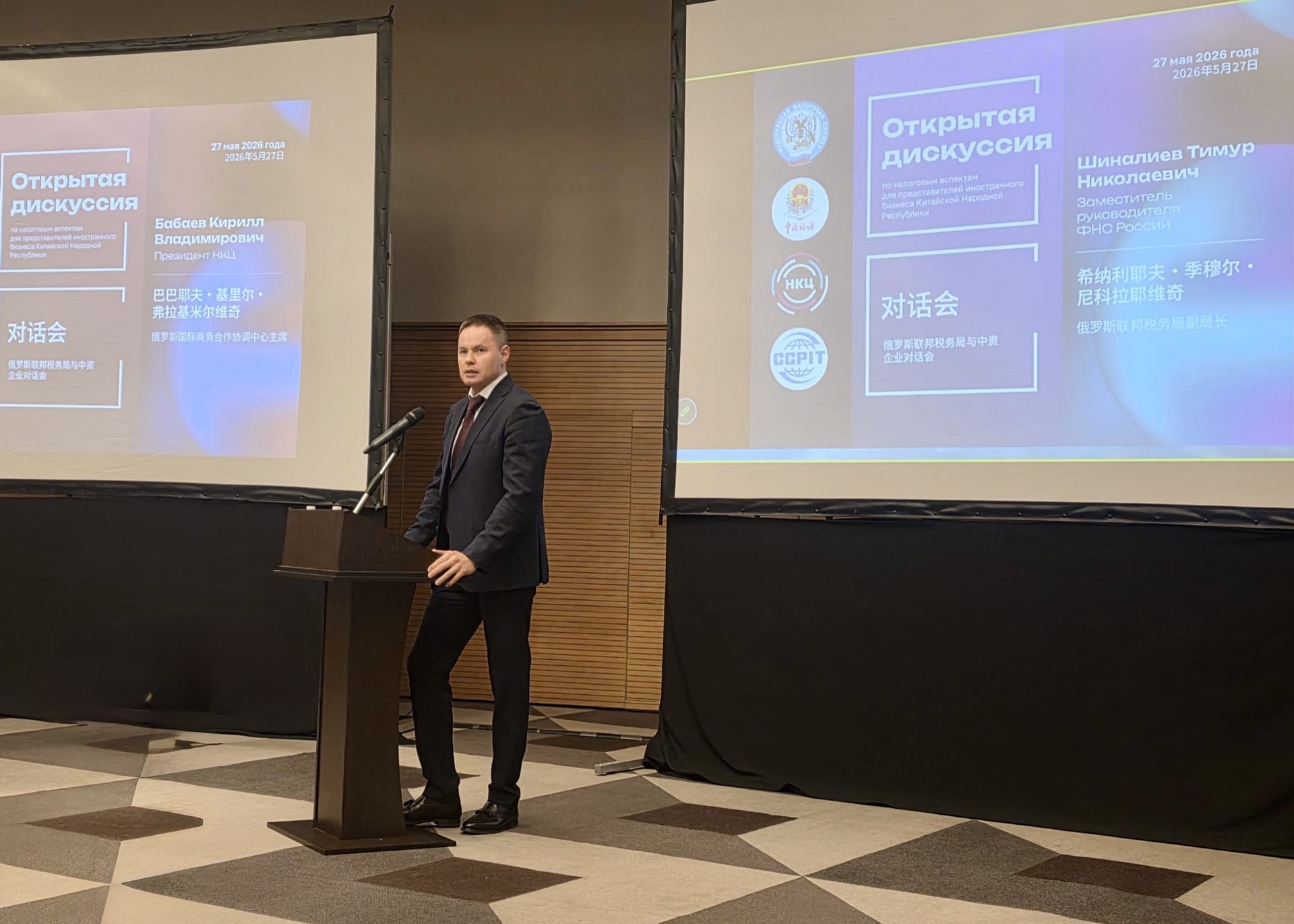
Issues related to adaptation to the Russian tax system, contract performance, and reducing tax risks were discussed at the open discussion “Tax Aspects for Foreign Businesses”.
“This conference is a good platform for exchanging views. Effective engagement requires constant dialogue. It is important to bring together all elements of business and the state,” noticed Huang Suhua, Deputy Head of the Department of International Taxation of the State Taxation Administration (STA) of China.
Timur Shinaliev, Deputy Commissioner of the FTS of Russia, noted that more than 14,000 companies with Chinese participation are currently operating in Russia. They are active across a wide range of sectors, including manufacturing, wholesale and retail trade, finance and insurance, as well as scientific and technical activities. “Such broad sectoral presence shows not only the scale of this presence, but also a sustained interest in long-term development in our market. Today, the Federal Tax Service of Russia faces the task of striking a balance between business interests and the requirements of Russian tax legislation. What matters is the predictability of tax rules and the ease of complying with obligations, while at the same time upholding the principles of fair competition,” he said.
Participants also discussed the introduction of the National System for Confirming the Expected Delivery of Goods (SPOT). This system is intended to improve the transparency of mutual trade within the Eurasian Economic Union and prevent indirect tax evasion. Its key elements are mandatory advance notification of deliveries and a security deposit payment, which guarantees that the relevant taxes are paid to the budget.
The Chinese side also expressed interest in Russia’s foreign exchange regulation and control. For example, international companies are generally treated as non-residents, except for those established by way of incorporation. Currently, residents may credit funds from non-residents to foreign accounts and foreign electronic payment instruments for any reason – including export revenue, refunds of import advances, or loan repayments. For legal entities and individual entrepreneurs, the requirement to repatriate funds has been suspended.
The parties also discussed the creation of the BRICS Tax Support Network. This practical instrument designed to help businesses operate more confidently in BRICS markets, get official answers to tax questions faster, and reduce uncertainty in their operational and investment activities. It is particularly relevant for companies that already do business in several BRICS countries or are planning to enter these markets. In such situations, tax issues often require a clear communication channel with the competent tax authority. When a company receives an official and timely response, it is easier to make decisions, plan operations, and assess business conditions in another country. Two rounds of requests have already been exchanged.
As part of the presentation of the BRICS Tax Support Network to representatives of Chinese business, participants were shown how the mechanism operates, the main advantages of using it, and the next steps to further develop and simplify the exchange of requests. Following the meeting, Chinese businesses were invited to submit their questions to the STA of China in order to receive an official response and further assistance from the FTS of Russia.
The event was organized by the National Coordination Center for International Business Cooperation, together with the China Council for the Promotion of International Trade (CCPIT), and the Interregional Tax Inspectorate No. 1 for Large Taxpayers of the FTS of Russia, which administers companies with foreign investment and serves as the sectoral competence center for organizations with foreign capital.